Many organizations begin with lung cancer.
The real opportunity lies in activating closed-loop patient management across service lines, programs, and facilities.
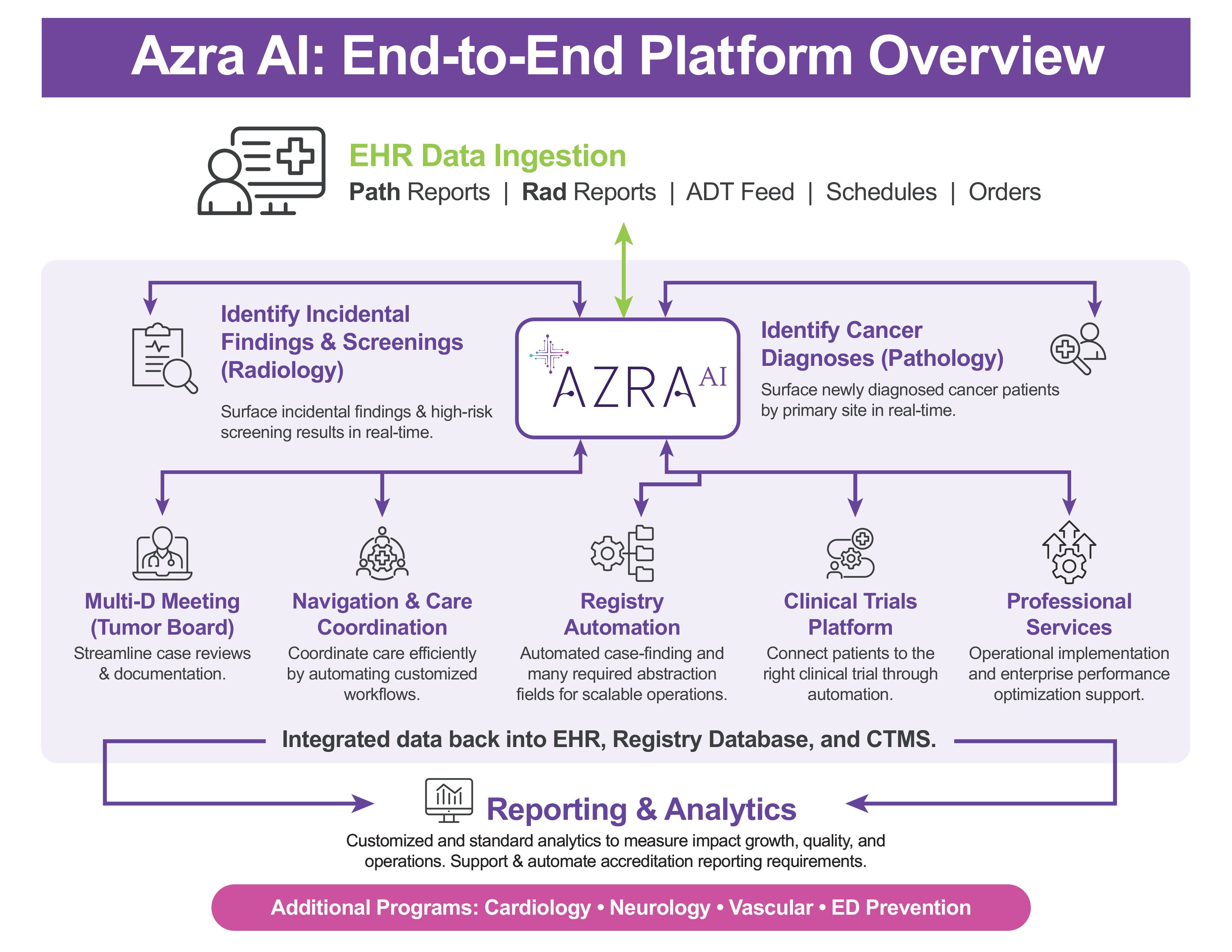
Azra AI enables health systems to standardize performance across cancer programs, Incidental Findings & Screening Programs, Registry Automation, Emergency-to-Outpatient Continuity, and Clinical Trials — ensuring care moves from documentation to completed care.
Azra ingests structured and unstructured clinical data directly from your EHR environment — pathology reports, radiology documentation, ADT feeds, schedules, and clinical orders — transforming fragmented signals into structured intelligence embedded within accountable workflows.
All capabilities integrate back into EHR systems, registry databases, and CTMS environments.
This is not a point solution.
It is enterprise closed-loop patient management infrastructure.

When Azra is initially deployed, the enterprise integration framework is established:
Enterprise expansion builds on that foundation. Activating additional capabilities does not require:
Expansion activates within your existing environment.
It is an extension of enterprise infrastructure — not a restart.
EHR platforms — including Epic, Cerner, and MEDITECH — serve as the system of record.
They capture documentation, orders, results, and transactions.
They are not designed to operationalize cross-disciplinary accountability across service lines.
Without a closed-loop patient management layer, health systems rely on:
Azra overlays your EHR with bidirectional integration — transforming stored clinical data into structured, accountable workflows embedded within existing systems.
Your EHR remains the system of record.
Azra becomes the enterprise patient management layer.
Expansion operationalizes EHR data at scale.
Standardize closed-loop workflows across additional oncology programs — breast, GI, pancreas, GYN, hematologic malignancies, and high-risk screening programs.
Eliminate variability across facilities and align multidisciplinary coordination within structured enterprise infrastructure.
Closed-loop infrastructure extends beyond oncology into additional enterprise programs.
Incidental Findings & Screening Programs support structured follow-up for imaging-driven findings — including structural heart indicators and abdominal imaging findings (including pancreas and renal).
Emergency-to-Outpatient Continuity ensures imaging-driven findings identified in the emergency department move into structured follow-up workflows.
Clinical Trials, Cardiology, and Registry Automation activate within the same shared integration and governance framework.
Each expansion pathway leverages the same integration, governance, and analytics infrastructure already in place.
Enterprise deployments across multi-facility health systems have demonstrated:
When pathology and radiology workflows are combined, enterprise ROI impact expands further.
Closed-loop patient management converts structured operational precision into measurable clinical and financial performance.
Expansion enables:
Organizations move from retrospective reporting to structured, forward-looking oversight.
Closed-loop patient management requires more than activation — it requires structured governance and operational alignment.
Azra's Professional Services — Clinical Partnership team works directly with clinical and operational leaders to standardize workflows, align KPIs, and ensure expansion translates into measurable performance across oncology programs and facilities.
This includes:
Professional Services is embedded clinical stewardship — ensuring sustained, accountable oncology performance at enterprise scale.
When 68-year-old Sarah arrived at the ER experiencing shortness of breath, her immediate concern was relief from her symptoms. However, her visit led to an unexpected and critical discovery. A CT scan revealed a 0.9 cm pulmonary nodule, an incidental finding that could have easily gone unnoticed.
Thanks to Azra AI's Patient Intelligence™, the pulmonary nodule was flagged in real time, prompting a lung navigator to initiate timely follow-up. During additional imaging, a 0.4 cm suspicious mass was detected in Sarah's right breast, an especially significant finding given that her recent mammogram had shown no abnormalities. The mass was diagnosed as invasive ductal carcinoma, caught at an extremely early and treatable stage.
Azra AI's seamless technology and care coordination ensured Sarah was quickly connected to a breast surgeon. She underwent a successful partial mastectomy, and her cancer was treated early, before it had a chance to progress. At just 4 mm, her tumor was detected well before the typical size range for early breast cancer findings, demonstrating how Azra AI helps ensure no patient falls through the cracks.
Schedule an enterprise expansion review to evaluate activation opportunities across your health system.